Designing the foundations of a cross-border hiring platform
Overview
Turning a complex international hiring service into a coherent digital product. I helped establish the foundations of the platform, bringing sourcing, screening, contracts, payroll, payments, benefits, and ongoing management into one connected experience.
Industries
Year
2024

Comuna was an early-stage platform designed to make international hiring simpler for US companies, with a particular focus on connecting them with talent across Latin America. Rather than acting only as a hiring marketplace, Comuna brought sourcing, screening, contracts, payroll, payments, benefits, and ongoing support into a single service.
I led the product design from the ground up, working across the experience, interface, and visual identity. At that stage, the challenge was less about optimizing an established product and more about turning a business proposition into something people could actually understand and use.
Turning a service into a product
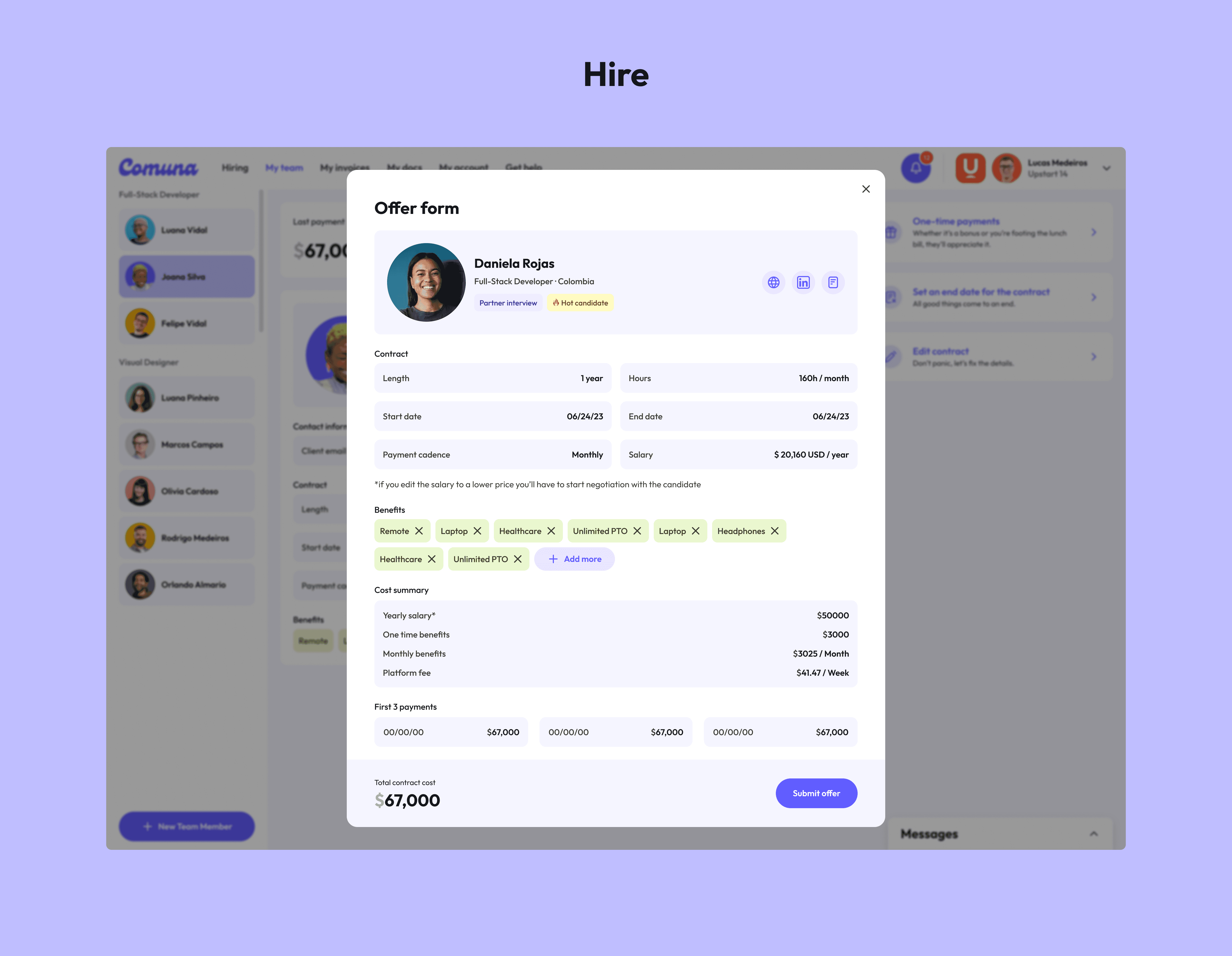
The business model involved several steps that traditionally happen across different services and providers. A company could submit a role, while Comuna would source and screen candidates, conduct cultural and technical interviews, and present a selection of pre-vetted people. Once someone was hired, the platform supported contracts, compliant employment, local-currency payments, bonuses and expenses, as well as configurable benefits and equipment.

The complexity wasn't only in the number of steps. The product had to make sense to two very different audiences: companies looking to hire internationally and contractors looking for stable work and support. I designed the underlying flows and information structure to make those different needs feel like parts of the same service rather than disconnected experiences.


Designing the experience from the ground up
With no mature product or established design system to build on, I worked across the entire design process, from requirements and user flows through wireframes, high-fidelity prototypes, and UI design.
A major part of the work was creating enough structure for the product to evolve consistently. I established a reusable UI library and style guide while designing the individual experiences, allowing patterns to be defined as the product itself was taking shape rather than added later as a layer of documentation.
This also meant thinking beyond individual screens. The interface needed to communicate a service that extended from the first hiring request all the way through the ongoing relationship between companies, contractors, and Comuna.


Designing the product and its identity together
Because Comuna was still being defined, the visual language was part of the product work rather than something that already existed around it. Alongside the interface, I developed the logo, visual identity, and supporting visual resources.
This gave me an opportunity to use my background in branding and visual design as part of the product definition itself. The goal was not simply to make the platform look consistent, but to give the experience a recognizable personality while creating a visual system that could support a growing product.


Designing for two sides of the relationship
The company and contractor experiences required different priorities. Companies needed clarity around roles, candidates, hiring decisions, and the operational aspects of working internationally. Contractors needed a straightforward way to understand opportunities, move through the hiring process, and access the support that came with working through Comuna.
Designing these experiences together helped define where the platform needed to be consistent and where it needed to adapt. The shared system created continuity across the product, while the individual flows were shaped around what each side needed to accomplish.



Building something that could grow
Comuna was designed at a point when many aspects of the product were still becoming defined. That made the work fundamentally different from refining a mature product with established patterns, analytics, and a large body of user feedback.
The most important contribution was therefore not a single screen or feature. It was establishing the foundations: a product structure, a reusable interface, and a visual language that could support the service as it developed.
The platform continues to be used today to connect hundreds of employees with overseas contractors. While I don't have the product metrics to attribute specific business outcomes to the design work, its continued use provides a clear indication that the foundations established during this early stage became part of a product that could persist and grow.
Designing what holds the product together
Working on Comuna reinforced something that has stayed important in my approach to product design: early-stage design is often about creating coherence before there is certainty.
When a product is still being defined, designing individual interfaces is only part of the job. The designer also has to give shape to the relationships between users, workflows, business rules, and visual language. In Comuna, that meant creating a foundation strong enough for the product to become more than the sum of its individual screens.
That experience shaped how I think about product design today. Good foundations don't just make the current experience clearer; they give a product room to become something more coherent as it grows.